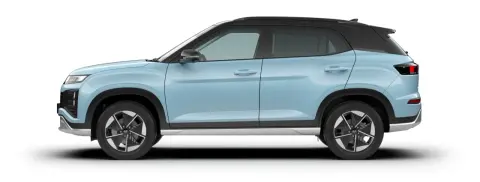
Why cars cost so much in Nepal: customs, excise and VAT on petrol cars explained
Wheels of Nepal · Last updated: · 8 min read
Petrol and diesel cars cost so much in Nepal because the taxes stack: customs duty of up to 80% on the car's import value, then excise duty that rises with engine size (from 60% to 105% in the FY 2026/27 Finance Bill), then 13% VAT on the whole lot. For the biggest engines, ISAS calculates the total import tax can reach 317% of the car's value.
This guide explains each layer in plain words, shows how they multiply, and puts real showroom prices next to the theory. It covers petrol and diesel cars. Electric cars are taxed very differently since the 2026/27 budget; our EV tax explainer covers them.
A note on the figures: we could not reach the Department of Customs or the Ministry of Finance websites while researching. The excise and road-fee rates below come from an unofficial text copy of the Finance Bill 2083 as tabled on budget day, and the customs rate from research and news reports. Treat them as a well-sourced guide, not as a customs assessment, and check the enacted Finance Act before relying on any single rate.
The four layers of tax on an imported petrol car
Almost every car sold in Nepal is imported. When it crosses the border, the importer pays:
- Customs duty, on the car's CIF value (its cost plus insurance and freight to the border). For conventional private passenger cars it is "as high as 80 per cent", according to the Institute of South Asian Studies (ISAS); the Kathmandu Post reported the same 80% rate on vehicle imports back in 2015.
- Excise duty, which grows with engine size, measured in cc. This is the layer that makes big engines so expensive.
- Road construction fee. The Finance Bill lists 10% for petrol and diesel cars.
- VAT at 13%, charged at the end on the value including the duties before it.
Then the distributor adds its own costs and margin, and you pay registration and the yearly road tax on top (see our bluebook and road tax guide).
Excise duty by engine size
These are the excise rates for fully built petrol and diesel cars in the excise schedule of the Finance Bill 2083, as tabled:
| Engine size | Petrol car excise | Diesel car excise |
|---|---|---|
| Up to 1,000 cc | 60% | 60% (diesel band is up to 1,500 cc) |
| 1,001–1,500 cc | 65% | 60% |
| 1,501–2,000 cc | 75% | 75% |
| 2,001–2,500 cc | not legible in the copy we read | 90% |
| 2,501–3,000 cc | 95% | 105% (diesel above 2,500 cc) |
| Above 3,000 cc | 105% | 105% |
Two practical lessons follow. First, the tax steps up at 1,000 cc, 1,500 cc and 2,000 cc, which is why so many cars sold in Nepal have engines just under those limits (998 cc, 1,197 cc, 1,462 cc, 1,497 cc and 1,999 cc all appear in our catalogue). Second, hybrids are not treated as electric cars: the same bill lists a flat 60% excise for petrol-electric hybrids. Our EV, hybrid or petrol guide looks at what that means for buyers.
How the taxes multiply: a worked example
The layers do not simply add up, because each one is charged on a value that already includes the previous duties. ISAS's maximum of 317% only works out that way. Here is our own arithmetic for a car with a CIF value of Rs 10 lakh, assuming the 80% customs rate, and leaving out the road construction fee (we could not confirm from an official source what value it is charged on):
| Step | 1,000 cc petrol (60% excise) | 1,200 cc petrol (65% excise) | 3,500 cc petrol (105% excise) |
|---|---|---|---|
| CIF value | Rs 10.00 lakh | Rs 10.00 lakh | Rs 10.00 lakh |
| + customs 80% | Rs 18.00 lakh | Rs 18.00 lakh | Rs 18.00 lakh |
| + excise on that | Rs 28.80 lakh | Rs 29.70 lakh | Rs 36.90 lakh |
| + VAT 13% | Rs 32.54 lakh | Rs 33.56 lakh | Rs 41.70 lakh |
| Tax as % of CIF | 225% | 236% | 317% |
The last column reproduces the 317% maximum that ISAS reports, which is how we know the duties compound in this order. So a car worth Rs 10 lakh at the border already costs more than three times that before the road construction fee, the importer's costs and the dealer's margin are added.
| Up to 1,000 cc | 32.54 lakh |
|---|---|
| 1,001–1,500 cc | 33.56 lakh |
| 1,501–2,000 cc | 35.6 lakh |
| 2,501–3,000 cc | 39.66 lakh |
| Above 3,000 cc | 41.7 lakh |
Source: Our arithmetic: 80% customs (ISAS), excise from Finance Bill 2083 as tabled, 13% VAT; road construction fee, margins and registration not included
What it means for showroom prices
You can see the engine bands in real price lists. These are the cheapest versions of some petrol cars in our catalogue, with their official engine sizes (indicative ex-showroom prices on the official sites, checked October 2026):
| Model | Engine | Starting price |
|---|---|---|
| Suzuki Alto K10 | 998 cc | Rs 28,24,000 |
| Hyundai Grand i10 Nios | 1,197 cc | Rs 33,56,000 |
| Suzuki Swift | 1,197 cc | Rs 38,99,000 |
| Suzuki Brezza | 1,462 cc | Rs 48,99,000 |
| Hyundai Creta | 1,497 cc | Rs 55,56,000 |
| Hyundai Tucson | 1,999 cc | Rs 1,07,96,000 |
| Subaru Crosstrek | 1,995 cc | Rs 1,40,00,000 |
| Hyundai Santa Fe | 2,497 cc | Rs 1,89,96,000 |
Price is not only tax, of course: a Tucson is a larger, better-equipped car than a Creta. But the jump from about Rs 56 lakh for a 1.5-litre SUV to more than Rs 1 crore for a 2.0-litre one shows how heavily the higher bands bite. Of the petrol cars in our catalogue with a published engine size, only five have engines above 1,500 cc, and the cheapest of them starts at Rs 1.08 crore.
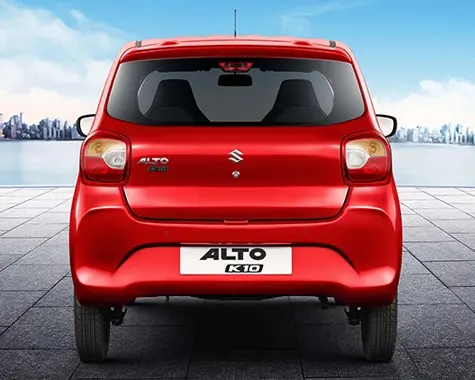 Suzuki Alto K10Rs 28.24 lakh – Rs 35.74 lakh
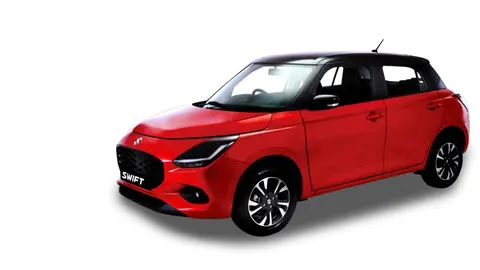 Suzuki Epic SwiftRs 38.99 lakh – Rs 52.29 lakh
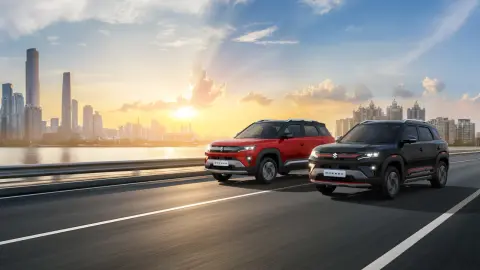 Suzuki BrezzaRs 48.99 lakh – Rs 72.29 lakh
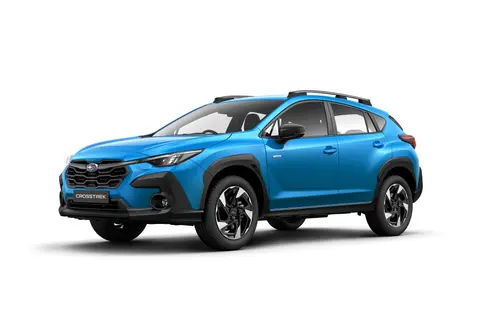 Subaru CrosstrekRs 1.4 crore – Rs 1.69 crore
Why the government taxes cars this way
Vehicle taxes are a big part of Nepal's revenue. ISAS found that over the past decade, vehicles and their accessories brought in about one-fifth to one-third of all customs revenue. The Kathmandu Post reported that in the first six months of FY 2023/24, vehicle imports worth Rs 36.31 billion generated Rs 26.51 billion in revenue, and called petrol and diesel vehicles, taxed at up to 261%, one of the government's highest revenue-earning imports.
Despite such importance of customs revenue generated from the import of conventional vehicles, Nepal has been encouraging the import and sale of EVs by imposing low duty rates.
The same tension shaped the 2026/27 budget: electric cars kept a lower customs duty (20%) but now pay a value-based fee instead of excise, which makes expensive EVs much dearer.
Petrol vs electric: the same Rs 10 lakh car
For comparison, here is the same arithmetic for an electric car with a CIF value of Rs 10 lakh under the FY 2026/27 rules reported by the Kathmandu Post (20% customs, a 2.5% clean infrastructure fee for EVs valued up to Rs 20 lakh, 13% VAT; road fee left out again):
| Step | 1,200 cc petrol | Electric (CIF up to Rs 20 lakh) |
|---|---|---|
| CIF value | Rs 10.00 lakh | Rs 10.00 lakh |
| After customs | Rs 18.00 lakh | Rs 12.00 lakh |
| After excise or clean infrastructure fee | Rs 29.70 lakh | Rs 12.30 lakh |
| After VAT 13% | Rs 33.56 lakh | Rs 13.90 lakh |
At this price level, the petrol car carries more than twice the tax-paid cost of the electric one. The gap narrows sharply for EVs valued above Rs 20 lakh, where the fee rises to 20% and beyond. Compare running costs with the EV vs petrol calculator.
What this means if you are buying
- Engine size matters twice: once in the import tax built into the price, and again every year in road tax.
- A "1.5" badge is not enough. Check the cc figure; a few cc can move a car into a higher band.
- Hybrids are taxed close to petrol cars, not like EVs.
- Prices move with the budget. Rates are set each year in the budget and the Finance Act. If you are deciding around budget time, wait until the new rates are confirmed.
- Financing: banks lend up to a fixed share of the price; see our auto loan guide and the EMI calculator.
Browse all car prices in Nepal to see where each model sits.
Sources
- ISAS (National University of Singapore) – Environment versus economy: Nepal's dilemma with electric vehicles, Brief No. 1083 (Puspa Sharma, 8 December 2023)
- The Kathmandu Post – Vehicle imports largest source of customs revenue (8 September 2015)
- The Kathmandu Post – EVs grab a third of auto import value (5 February 2024)
- The Kathmandu Post – Revised tax slabs threaten EV boom in Nepal (1 June 2026)
- Finance Bill 2083 (as tabled) – unofficial text copy of the Ministry of Finance PDF (excise schedule and road construction fee for HS 8703)
- ICAN – Highlights of the federal budget of Nepal FY 2083/84
- Suzuki Nepal (CG Motocorp) – price list (Alto K10, Swift, Brezza)
- Laxmi Hyundai – price list (Grand i10 Nios, Creta, Tucson, Santa Fe)
- Subaru Nepal (Vijay Motors) – Crosstrek (price and engine)
#tax#customs#excise#petrol-cars#budget-2026-27#buying-guide