Auto loans in Nepal explained: loan limit, interest rates and EMI examples
Wheels of Nepal · Last updated: · 10 min read
In Nepal a bank can lend at most 60% of a private vehicle's price, petrol or electric, so you need at least 40% as a down payment. The interest rate on most auto loans is the bank's base rate plus a premium that is fixed in your offer letter.
Most people in Nepal do not pay the full price of a car or bike in cash. They put down part of the money and borrow the rest from a bank or finance company. That loan is shaped by two things: a ceiling set by Nepal Rastra Bank (NRB), and the way your bank prices the interest. This guide explains both, lists the papers banks ask for, and works through EMI examples so you can see the real monthly cost before you visit a showroom.
How much can you borrow? The 60% rule
NRB limits how much of a vehicle's value a bank can lend. This limit is called the loan-to-value ratio (LTV).
- Private vehicles: 60%, whether petrol, diesel or electric. NRB set this single 60% cap in the mid-term review of its FY 2024/25 monetary policy (February 2025). Before that, electric vehicles could be financed up to 80% of their value; the review brought EVs down to the same 60% as other private vehicles.
- The FY 2026/27 monetary policy (July 2026) did not change the private-vehicle limit. It only promised to relax the LTV for electric vehicles used in public transport.
- Large electric public transport vehicles: up to 80%. A follow-up NRB directive in July 2026 allowed banks to lend up to 80% for these, as reported by Hamro Patro News. This does not apply to a private car or scooter.
- Replacement of commercial vehicles damaged in the Gen Z unrest: up to 80%, under a separate NRB relief provision reported in September 2025. Again, not for ordinary private buyers.
So the owner's belief is correct for private buyers, with one clarification: EVs no longer get a higher limit. Private EVs are capped at 60% too. We could not open NRB's own website while researching this post, so the figures above come from news reports of the policy and directives. Ask your bank to confirm the limit on the day you apply.
In practice this means you need at least 40% of the price as your own down payment. Banks apply the 60% to the vehicle quotation; Nepal Bank's auto loan page, for example, sets its limit at 60% of the quotation price or whatever NRB directives allow. Remember that registration, insurance and the first year's road tax come on top, so budget for those separately (see our guide to bluebook renewal, road tax and insurance).
How banks price an auto loan: base rate plus premium
Nepali banks offer two kinds of rate.
Floating rate (base rate + premium)
Most loans use a floating rate:
Your interest rate = the bank's base rate + a premium
- The base rate reflects the bank's own cost of funds. Banks recalculate it every month and publish it. When deposit rates fall, base rates usually fall too, and the reverse.
- The premium is the extra margin the bank adds for your loan type and risk. It is written in your offer letter.
Under NRB's Unified Directive (Directive 15, as summarised by the legal commentator Sushil Parajuli), the premium stated in your offer letter cannot later be raised by the bank for the life of the loan. Only the base rate part moves, and it moves automatically. That means your EMI can go up or down over the years even though you never signed anything new.
A real example of published rates. Nepal Bank Limited's rate sheet effective Kartik 1, 2083 lists:
| Loan type (Nepal Bank, floating) | Rate |
|---|---|
| Private vehicle, 5-year term | Base rate + 0.49 to 2.49 points |
| Private vehicle, 7-year term | Base rate + 0.75 to 2.49 points |
| Electric vehicle | Base rate + 1.00 to 2.50 points |
Nepal Bank's published base rate was 4.37% for Bhadra 2083. For example, at that base rate a 5-year private vehicle loan would come to between 4.86% (4.37 + 0.49) and 6.86% (4.37 + 2.49). The premium you get within that range depends on the bank's assessment of you. Other banks publish different numbers, so compare several.
Fixed rate
Some banks also offer a fixed rate that does not move with the base rate. Nepal Bank's sheet lists fixed auto loans at 7.99% for 5 years or 8.50% for 7 years, and its EV loan at 7.90% for 5 years or 8.50% for 7 years. A fixed rate costs more today than the low end of the floating range, but it protects you if base rates rise again.
Which should you choose? If you can absorb an EMI that rises by a few thousand rupees, floating is usually cheaper while base rates are low. If your budget is tight and you want certainty, fixed is safer. Ask the bank how often a fixed rate can be reviewed; under the directive this is only after several years and with your written consent.
Documents banks usually ask for
Every bank has its own checklist, but the list below, based on Nepal Bank's published requirements, is typical.
| Category | Documents |
|---|---|
| Identity | Citizenship certificate, National ID or passport for you and any guarantor; recent photos; family details from the ward office where asked |
| The vehicle | Quotation from the dealer showing model, variant and price |
| Salaried income | Salary certificate, appointment letter, about 6 months of bank statements |
| Business income | Firm registration, PAN/VAT certificate, audited financial statements, tax clearance |
| Other income | Rental agreement and rent tax receipts, or pension papers, if used |
| Larger loans | PAN of the borrower (Nepal Bank asks for it on loans of Rs 25 lakh and above) |
Nepal Bank says borrowers must be Nepali citizens aged 18 or over with a steady income, and it offers terms of 2 to 7 years for new vehicles. Other banks set different minimum ages and maximum terms.
Until the loan is repaid, the bank's interest is recorded on your bluebook. When you finish paying, collect a release letter from the bank and get the record cleared at the transport office; you will need this if you ever sell (see how to buy a used car in Nepal).
The EMI formula
EMI (equated monthly instalment) is the fixed monthly amount that pays off interest and principal over the term. The standard formula is:
EMI = P × r × (1 + r)ⁿ ÷ ((1 + r)ⁿ − 1)
- P = loan amount
- r = monthly interest rate = annual rate ÷ 12 ÷ 100
- n = number of months
For a floating loan, the EMI is recalculated whenever the rate changes, so treat these results as a snapshot.
Worked EMI examples
All of the following are examples for illustration, using the rates quoted above. Your actual rate, fees and EMI will depend on your bank and your profile.
Example 1: a Rs 40 lakh car, 5 years fixed
- Price: Rs 40,00,000. Maximum loan at 60%: Rs 24,00,000. Down payment: Rs 16,00,000.
- Rate: 7.99% fixed (Nepal Bank's published 5-year fixed auto rate). r = 7.99 ÷ 12 ÷ 100 = 0.006658. n = 60.
- (1 + r)⁶⁰ = 1.4891.
- EMI = 24,00,000 × 0.006658 × 1.4891 ÷ 0.4891 ≈ Rs 48,650 a month.
- Total repaid ≈ Rs 29.19 lakh, so the interest is about Rs 5.19 lakh.
Example 2: the same loan over 7 years
- Rate: 8.50% fixed (published 7-year fixed rate). r = 0.007083, n = 84, (1 + r)⁸⁴ = 1.8092.
- EMI ≈ Rs 38,000 a month.
- Total repaid ≈ Rs 31.93 lakh, so the interest is about Rs 7.93 lakh.
A longer term cuts the EMI by about Rs 10,650 but adds roughly Rs 2.7 lakh of interest.
Example 3: the same loan on a floating rate
- Assume a floating rate of 6.00% for the whole 5 years (inside the range worked out above, but not guaranteed to stay there).
- EMI ≈ Rs 46,400 a month; interest ≈ Rs 3.84 lakh.
- If the base rate rises, this EMI rises with it.
| 5 years, 7.99% fixed | 5.19 lakh |
|---|---|
| 7 years, 8.50% fixed | 7.93 lakh |
| 5 years, 6.00% floating (assumed) | 3.84 lakh |
Source: Worked Examples 1–3 in this article, using Nepal Bank Limited's published rates (effective Kartik 1, 2083); the 6.00% floating rate is an assumption
Example 4: an electric car
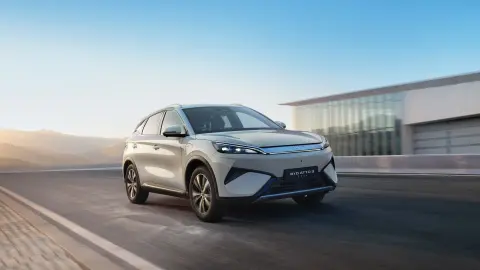
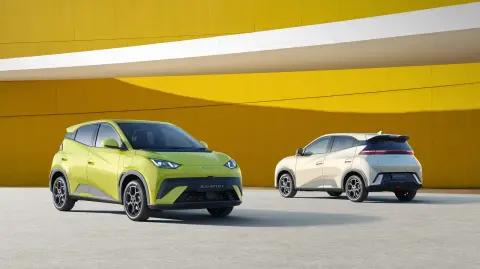
- The BYD Atto 1 Dynamic has an indicative ex-showroom price of Rs 30,75,000 on the official site (checked October 2026).
- Loan at 60%: Rs 18,45,000; down payment Rs 12,30,000.
- At 7.90% fixed for 5 years (Nepal Bank's published EV fixed rate): EMI ≈ Rs 37,320 a month, interest ≈ Rs 3.94 lakh.
Example 5: a scooter
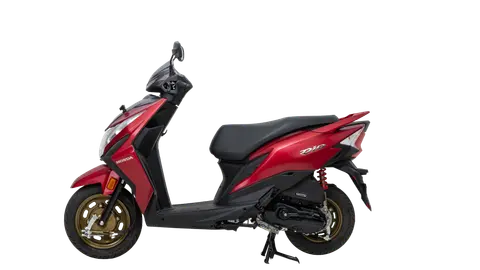
- The Honda Dio 110 STD lists at Rs 2,69,900 on the official site (checked October 2026). A 60% loan is Rs 1,61,940.
- Assuming 8% for 3 years: EMI ≈ Rs 5,075 a month, interest ≈ Rs 20,750.
To try your own numbers, use our EMI calculator. It defaults to a 40% down payment, matching the NRB limit.
Checklist before you sign
- Compare at least three banks. Look at the premium range, not just the advertised lowest rate.
- Ask for every fee in writing: loan processing or service charge, valuation, documentation, and any charge for paying off early. Banks publish their service charges; we have not listed them because they differ widely.
- Check the premium in the offer letter. That is the number that stays fixed.
- Plan the full cost, not just the showroom price. Registration, road tax and insurance come on top; see our guide to road tax and insurance.
- Keep the EMI comfortable. Leave room for fuel or charging, insurance, tax and servicing. If you are weighing an EV, our EV vs petrol cost calculator shows the running-cost side.
- Don't stretch the term just to afford a bigger car. As Example 2 shows, a longer term costs real money.
If you are still choosing, our first-time car buyer's guide and the car price list are good next steps.
Sources
- Business 360 – Monetary policy mid-term review: vehicle loan ratio set at 60% (26 February 2025)
- eNewsPolar – NRB mid-term review of monetary policy: changes in loan provisions (26 February 2025)
- The HRM Nepal – Monetary Policy 2026/27 (21 July 2026)
- Hamro Patro News – Central bank raises loan limit for electric public transport vehicles to 80% (16 July 2026)
- NEPSE Trading – Vehicle loan rules revised: 60% LTV, 80% only for replacement vehicles (27 September 2025)
- Nepal Bank Limited – Auto loan: eligibility, documents, tenure and LTV
- Nepal Bank Limited – Interest rates (effective Kartik 1, 2083)
- Nepal Bank Limited – Base rate history
- Sushil Parajuli – How floating interest rates work under NRB Unified Directive 15 (updated 12 September 2026)
#auto-loan#emi#nrb#interest-rate#base-rate#ev#buying-guide